
Many beginners who want to learn how to lucid dream without sleep paralysis have the same concern.
They’ve heard stories about sleep paralysis and worry that lucid dreaming automatically leads to it. In reality, that’s not the case. While sleep paralysis can sometimes be connected to lucid dreaming, it is not the only way to enter a lucid dream.
Some lucid dream techniques may involve passing through a sleep paralysis state, especially methods like Wake-Induced Lucid Dreams (WILD).
However, many people successfully lucid dream without sleep paralysis by using other techniques that don’t rely on staying conscious while the body falls asleep.
One reason sleep paralysis feels frightening to some people is that they don’t fully understand what’s happening.
Others become scared when they realize they can’t move, or they have had unpleasant experiences in the past that make the situation feel more intense. Once fear takes over, the experience often feels much worse.
The good news is that sleep paralysis itself is generally a temporary and natural state that occurs between wakefulness and sleep. For people who understand what is happening, it can feel far less intimidating than the stories often shared online.
If your goal is to learn how to lucid dream without sleep paralysis, the first step is to reduce the fear surrounding it. Anxiety can make it harder to relax, and relaxation is one of the most important parts of successful lucid dreaming.
A helpful way to overcome this fear is by learning more about sleep paralysis and understanding how it works. When something is unfamiliar, it’s easy to imagine the worst. Once you understand the experience, it often becomes much less frightening.

Think about it this way. It’s reasonable to be concerned about a real danger, such as riding in a car with a reckless driver.
But worrying about a possible dream experience that may never happen can create unnecessary stress and make it harder to enjoy the process of learning lucid dreaming.
The more you educate yourself about sleep paralysis and lucid dreaming, the more confident you’ll feel. And when you approach lucid dreaming with confidence instead of fear, you’ll have a much better chance of achieving your first lucid dream.
Before moving on, it helps to understand what a typical sleep paralysis experience feels like and how some people naturally transition from that state into a lucid dream.
What is The Real Chance of Experiencing Sleep Paralysis?
Many people successfully learn how to lucid dream without sleep paralysis and may go years without experiencing it at all.
This is especially common for those who focus on Dream-Initiated Lucid Dreams (DILDs), where awareness develops during a dream rather than while falling asleep. Because of this, sleep paralysis is not something every lucid dreamer encounters regularly.
Even when sleep paralysis does happen, the experience can vary from person to person.
Some people find it strange or unsettling at first, while others remain calm because they understand what is happening. Knowing that the experience is temporary often makes a big difference.
One reason sleep paralysis has gained such a frightening reputation is that it can feel incredibly realistic.
During the experience, some people report seeing shadows, figures, strange lights, or hearing unusual sounds. Because these sensations can seem so real, many have interpreted them as ghosts, aliens, demons, or other supernatural encounters.
However, these experiences occur while the brain is in a unique state between sleeping and waking. Understanding this can help reduce much of the fear surrounding sleep paralysis and lucid dreaming.
At the same time, it’s important to acknowledge that some people experience frequent sleep paralysis episodes that can be genuinely distressing.
For those who don’t understand what’s happening, repeated episodes can lead to anxiety and fear around sleep itself.
Fortunately, you’re already taking an important step by learning about the process.
When you understand what sleep paralysis is and how it relates to lucid dreaming, you’re far less likely to be caught off guard by the experience.
If your goal is to lucid dream without sleep paralysis, there are many techniques that can help you achieve that. Even if you eventually experience sleep paralysis at some point, you’ll be prepared and know exactly what’s happening rather than feeling frightened by the unknown.
So what are the chances of experiencing sleep paralysis while practicing lucid dreaming?
For most people, the chances are relatively low, especially when using dream-based techniques rather than methods that involve staying conscious as the body falls asleep.
However, certain practices, such as Wake-Induced Lucid Dreaming (WILD), may increase the likelihood of entering a sleep paralysis state because they work directly with the transition between wakefulness and sleep.
Some lucid dreaming supplements may also increase the chances of experiencing sleep paralysis.
Even so, most beginners who want to learn how to lucid dream without sleep paralysis can successfully practice lucid dreaming for a long time without ever having a significant sleep paralysis experience.
How to lucid dream without sleep paralysis?
For some people, sleep paralysis is something they hope to avoid completely. The experience can feel strange, uncomfortable, or even frightening if they don’t know what’s happening.
For others, sleep paralysis is simply part of their lucid dreaming journey. Some advanced techniques use this state as a bridge into a lucid dream, and experienced dreamers may even welcome it.
This naturally leads to an important question:
Is It Possible to Have a Lucid Dream Without Sleep Paralysis?
The simple answer is yes.
In fact, many people learn how to lucid dream without sleep paralysis and have regular lucid dreams without ever experiencing it.
Techniques such as reality checks, dream journaling, and Dream-Initiated Lucid Dreams (DILDs) allow dreamers to become aware inside a dream without passing through a sleep paralysis state.
That said, no method can completely guarantee that sleep paralysis will never happen. Sleep paralysis is a natural sleep phenomenon that can occur whether you’re practicing lucid dreaming or not.
However, if your goal is to lucid dream without sleep paralysis, there are several techniques and habits that can significantly reduce the chances of experiencing it.
By choosing the right lucid dreaming methods and maintaining healthy sleep patterns, many dreamers are able to enjoy lucid dreams while avoiding the discomfort that sleep paralysis can sometimes bring.
In the following sections, we’ll explore some of the most effective ways to increase your chances of lucid dreaming without sleep paralysis and make the experience feel more comfortable and enjoyable.
Read : 5 easy step to practice Wake Initiated Lucid Dreaming
Can Lucid Dreaming Cause Sleep Paralysis?
Yes, lucid dreaming can sometimes increase the chances of experiencing sleep paralysis, especially when using certain lucid dream techniques.
Methods such as Wake-Induced Lucid Dreaming (WILD) involve staying mentally aware while your body falls asleep. Because of this, some people may pass through a temporary sleep paralysis state before entering a lucid dream.
Although lucid dreaming and sleep paralysis are different experiences, they are closely connected.
A lucid dream happens when you become aware that you’re dreaming while the dream is still taking place. Sleep paralysis, on the other hand, occurs when your mind becomes conscious before your body has fully awakened from sleep.
In both cases, awareness plays an important role. That’s one reason researchers believe there is a connection between sleep paralysis and lucid dreaming.
However, it’s important to remember that experiencing sleep paralysis is not a requirement for lucid dreaming.
Many people learn how to lucid dream without sleep paralysis by using techniques that focus on gaining awareness during a dream rather than during the process of falling asleep.
If avoiding sleep paralysis is one of your main concerns, choosing beginner-friendly methods such as dream journaling, reality checks, and Dream-Initiated Lucid Dreams (DILDs) can be a good place to start.
The key thing to understand is that while some lucid dream techniques may increase the likelihood of sleep paralysis, lucid dreaming itself does not automatically cause it.
Many dreamers have frequent lucid dreams and rarely, if ever, experience sleep paralysis.
Lucid Dream Techniques That Can Help You Avoid Sleep Paralysis
If you’re looking for ways to learn how to lucid dream without sleep paralysis, choosing the right technique can make a big difference.
While no method can completely guarantee that sleep paralysis will never occur, some lucid dream techniques are generally less likely to trigger it because they focus on becoming aware during a dream rather than during the process of falling asleep.
Here are some of the most popular methods for lucid dreaming without sleep paralysis.
1. Writing-Induced Lucid Dreaming (WrILD)
The WrILD technique uses writing as a way to strengthen your intention to become lucid while dreaming.
Before going to bed, choose a simple phrase such as:
“Tonight, I will realize I’m dreaming.”
Write the phrase repeatedly in a notebook until it becomes firmly planted in your mind. Some dreamers also like to write down the lucid dream they hope to experience, imagining the details as they write.
This practice helps focus your thoughts on lucid dreaming before sleep and may increase your chances of becoming aware inside a dream naturally.
2. Mnemonic Induction of Lucid Dreams (MILD)
MILD is one of the most beginner-friendly lucid dreaming techniques.
As you’re falling asleep, repeat a phrase or intention to yourself, such as:
“The next time I dream, I will realize I’m dreaming.”
The goal is to train your mind to recognize when you’re dreaming. Over time, this simple mental exercise can improve dream awareness without requiring you to stay conscious while your body falls asleep.
Because of this, many people use MILD when learning how to lucid dream without sleep paralysis.
3. Dream-Initiated Lucid Dreams (DILD)
Dream-Initiated Lucid Dreaming, or DILD, is one of the most common forms of lucid dreaming.
Rather than using a single technique, DILD refers to becoming aware while you’re already inside a dream.
Many daytime practices can increase the chances of a DILD, including:
- Performing reality checks throughout the day
- Keeping a dream journal
- Paying closer attention to your surroundings
- Improving overall dream recall
These habits help train your mind to become more aware, making it easier to recognize when you’re dreaming.
4. Video Game-Induced Lucid Dreaming (VGILD)
Some studies and dreamers have reported that playing video games may increase the likelihood of lucid dreaming.
Video games often encourage problem-solving, environmental awareness, and immersion, which may carry over into dreams and improve dream awareness.
However, moderation is important. Playing intense games late at night can interfere with sleep quality, which may negatively affect your ability to remember dreams and achieve lucid dreaming.
For best results, maintain a healthy sleep schedule and avoid overstimulation close to bedtime.
Which Technique Is Best for Lucid Dreaming Without Sleep Paralysis?
For most beginners, MILD and DILD are often considered the best starting points.
These methods focus on developing awareness within dreams rather than staying conscious during the transition into sleep, making them popular choices for people who want to lucid dream without sleep paralysis.
The key is to experiment with different techniques and find the approach that feels most comfortable for you.
Read : Top 10 Lucid Dreaming Benefits: Unlock Your Mind’s Full Potential While You Sleep
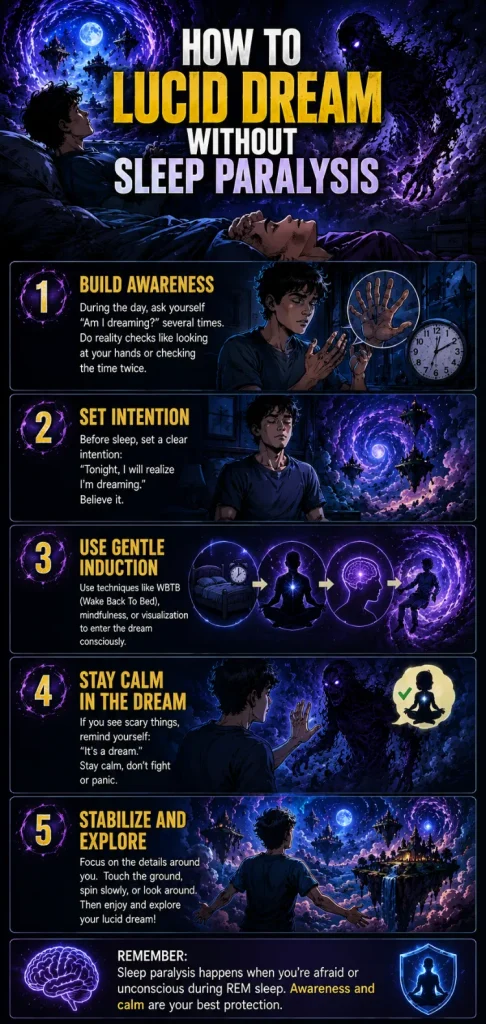
How to lucid dream without sleep paralysis: Step-by-step guide
If you want to learn how to lucid dream without sleep paralysis, the best place to start is with healthy sleep habits and beginner-friendly lucid dream techniques.
While no method can completely eliminate the possibility of sleep paralysis, following the right practices can significantly reduce the chances of experiencing it while improving your overall success with lucid dreaming.
1. Improve Your Sleep Quality
Good sleep is the foundation of both lucid dreaming and overall well-being.
A consistent sleep schedule helps your mind and body move through sleep cycles more efficiently, which can make dream recall and lucid dreaming easier.
To improve your sleep quality:
- Go to bed and wake up at the same time each day.
- Reduce screen time before bed.
- Keep your bedroom dark, quiet, and comfortable.
- Avoid activities that leave you overstimulated before sleep.
The better your sleep quality, the more naturally lucid dreaming tends to develop.
2. Practice Relaxation before Bed
Stress and anxiety can make it harder to fall asleep peacefully and may increase concerns about sleep paralysis.
Before going to bed, spend a few minutes relaxing your mind.
You can try:
- Meditation
- Deep breathing exercises
- Gentle stretching
- Mindfulness practices
Relaxation helps create a calm mental state, which is ideal for lucid dreaming.
3. Keep a Dream Journal
Dream journaling is one of the most effective ways to improve dream awareness.
As soon as you wake up, write down everything you remember about your dreams. Include important details, emotions, people, locations, and unusual events.
Over time, this practice strengthens your dream recall and helps you recognize recurring dream patterns, making it easier to become lucid during future dreams.
4. Learn From Other Lucid Dreamers
The more you learn about lucid dreaming, the more familiar and achievable it becomes.
Reading articles, books, and personal experiences from other lucid dreamers can help you understand different techniques and build confidence in your ability to lucid dream.
Knowledge also reduces unnecessary fear surrounding sleep paralysis and lucid dreaming by replacing uncertainty with understanding.
A Simple Method for Lucid Dreaming Without Sleep Paralysis
Unlike techniques such as WILD, which may increase the chances of entering a sleep paralysis state, many beginner-friendly methods rely on intention and dream awareness.
Here’s a simple approach you can try:
Step 1: Choose a Positive Mantra
Pick a phrase that feels natural and meaningful to you.
Examples include:
- “When I dream, I will realize I’m dreaming.”
- “I can become aware in my dreams.”
- “Tonight I will have a lucid dream.”
Choose a positive statement that you genuinely believe and feel comfortable repeating.
Step 2: Write It Down
Write your chosen mantra several times in a notebook. this will guide you to practice safe lucid dream without sleep paralysis.
Continue until the phrase feels familiar and fully absorbed into your thoughts. This helps strengthen your intention before sleep.
Step 3: Imagine Your Ideal Lucid Dream
Spend a few minutes visualizing a dream you would like to experience.
Picture the setting, the people, the emotions, and the activities you want to explore. The more vivid your imagination, the easier it may be to recognize that you’re dreaming later on.
Step 4: Repeat the Mantra Before Sleep
As you drift off to sleep, quietly repeat your mantra in your mind.
If you wake up during the night, repeat the mantra again as you fall back asleep. This helps keep your intention focused on becoming aware during your dreams.
With consistency and patience, this simple practice can increase your chances of lucid dreaming without sleep paralysis while helping you build stronger dream awareness over time.
What Is a Sleep Paralysis Demon?
One of the biggest fears people have when learning how to lucid dream without sleep paralysis is the possibility of encountering a so-called “sleep paralysis demon.”
During an episode of sleep paralysis, some people report seeing a dark figure, shadowy presence, or strange shape in the room.
Others feel as though someone is standing nearby, watching them, or pressing down on their chest. These experiences can feel incredibly vivid and frightening.
The important thing to understand is that the figure is not real.

A sleep paralysis demon is not a supernatural being, and it cannot harm you. It is a temporary hallucination that can occur when your mind becomes aware while parts of your brain are still transitioning between sleep and wakefulness.
Even though the experience isn’t physically dangerous, it can feel very real in the moment. Many people describe it as one of the most intense and unsettling experiences they’ve ever had.
This is completely understandable. When you’re unable to move and your senses are producing realistic images, sounds, or feelings, it’s natural for your brain to interpret the situation as a threat.
The good news is that sleep paralysis episodes are usually brief and often last only a few seconds to a couple of minutes before ending on their own.
One of the best ways to reduce fear is through understanding. The more you learn about sleep paralysis and lucid dreaming, the easier it becomes to recognize what’s happening if it ever occurs.
For people who want to lucid dream without sleep paralysis, knowledge can be a powerful tool. When you understand that these experiences are a normal part of the sleep process rather than something dangerous, they often become much less intimidating.
In many cases, fear comes from the unknown. Once you know what sleep paralysis is and why it happens, the experience tends to lose much of its power over your thoughts and emotions.
Read : The Rausis Lucid Dreaming Technique: A 100% Powerful Guide to Instant Lucid Dreams
How to have a lucid dream without sleep paralysis – Conclusion
Learning how to lucid dream without sleep paralysis is completely possible, and many people achieve lucid dreams without ever experiencing sleep paralysis at all.
While certain techniques, such as Wake-Induced Lucid Dreaming (WILD), may increase the chances of entering a sleep paralysis state, they are far from the only path to becoming lucid.
Methods like dream journaling, reality checks, MILD, DILD, and other awareness-based techniques allow you to develop lucid dreaming skills in a more gradual and comfortable way.
If fear of sleep paralysis has been holding you back, remember that knowledge is one of the best ways to overcome that fear.
Understanding what sleep paralysis is, why it happens, and how it relates to lucid dreaming can make the experience feel far less intimidating.
Even if you encounter it one day, you’ll know that it is temporary, harmless, and a natural part of the sleep process.
The most important thing is to focus on building healthy sleep habits, improving dream recall, and practicing techniques that feel right for you. Lucid dreaming is a skill that develops over time, and patience often produces better results than trying to force an experience.
As you continue your journey, stay curious, keep learning, and enjoy the process. With consistent practice and the right approach, you can increase your chances of having vivid lucid dreams while minimizing concerns about sleep paralysis.
The key takeaway is simple: don’t let the fear of sleep paralysis stop you from exploring lucid dreaming.
By choosing beginner-friendly methods and maintaining a positive mindset, you can confidently learn how to lucid dream without sleep paralysis and enjoy the incredible experiences that lucid dreaming has to offer.
FAQ
1. What Is the Difference Between a Lucid Dream and Sleep Paralysis?
A lucid dream happens when you become aware that you’re dreaming while the dream is still taking place. In some cases, you may even be able to influence or control parts of the dream.
Sleep paralysis, on the other hand, occurs when your mind wakes up before your body fully exits sleep mode. During this brief period, you may be aware of your surroundings but unable to move or speak.
While sleep paralysis and lucid dreaming are related, they are not the same experience. Many people have lucid dreams without ever experiencing sleep paralysis.
Can Sleep Paralysis and Lucid Dreaming Happen at the Same Time?
Yes, it’s possible for sleep paralysis and lucid dreaming to overlap.
This most commonly happens during techniques like Wake-Induced Lucid Dreaming (WILD), where you remain mentally aware as your body falls asleep. Some dreamers pass through a sleep paralysis state before entering a lucid dream.
However, not everyone experiences this transition, and it is not required for successful lucid dreaming.
3. Do You Always Get Sleep Paralysis When Lucid Dreaming?
No. This is one of the biggest myths about lucid dreaming.
Many beginners worry that lucid dreaming automatically causes sleep paralysis, but that’s simply not true. Most lucid dreams occur naturally during sleep without any episode of sleep paralysis.
Techniques such as dream journaling, reality checks, MILD, and DILD can help you learn how to lucid dream without sleep paralysis, making them popular choices for beginners.
4. Why Do Some People Experience Sleep Paralysis When Trying to Lucid Dream?
Sleep paralysis can occur when your mind becomes conscious while your body is still in a sleep state.
Certain lucid dreaming methods, especially WILD, intentionally work with the transition between wakefulness and sleep. Because of this, they may increase the chances of experiencing sleep paralysis.
It’s important to remember that sleep paralysis is a natural sleep phenomenon and can happen even to people who have never attempted lucid dreaming.
5. How Do You Snap Out of Sleep Paralysis?
The most effective thing you can do is stay calm and remind yourself that the experience of lucid dream without sleep paralysis is temporary.
Many people find that focusing on small movements, such as wiggling their fingers, toes, or blinking their eyes, helps them regain full control of their body more quickly.
Slow, steady breathing can also reduce panic and make the experience feel less intense. In most cases, sleep paralysis ends on its own within a few seconds to a couple of minutes.
The more familiar you become with sleep paralysis, the less frightening it tends to feel if it ever happens.