
What Are Precognitive Dreams? What if your dreams could give you a glimpse of the future?
Have you ever dreamed about something that later happened in real life? Or experienced a situation and suddenly realized you had already seen it in a dream a few days earlier?
Many people describe these experiences as more than simple coincidence. The emotions often feel vivid, personal, and unforgettable, making them difficult to ignore.
So, could there be a real explanation behind Precognitive Dreams?
In this guide, you’ll learn:
- What are Precognitive Dreams?
- Are precognitive dreams real?
- Why do some people experience them?
- What causes precognitive dreams?
- Famous examples of precognitive dreams
- The connection between precognitive dreams and déjà vu
- What do precognitive dreams about death mean?
- How do precognitive dreams work?
- Can lucid dreaming help you experience precognition?
While there is no scientific proof that dreams can accurately predict future events, researchers have found that some dreams may reflect changes happening inside the body.
For example, some studies suggest that certain dream patterns may be linked to future health changes.
In people living with Parkinson’s disease, dreams filled with strong negative emotions have been associated with a greater risk of later cognitive decline.

Dream content can also change during different stages of life.
Pregnancy often leads to more vivid dreams and frequent nightmares. Likewise, trauma, stress, anxiety, and other mental health challenges can increase the likelihood of disturbing dreams, which may also affect overall sleep quality.
Sometimes, people experience lucid dreams, where they become aware that they are dreaming. In many cases, they can even influence or control parts of the dream.
Although lucid dreaming does not allow someone to predict the future, it offers a unique level of awareness that continues to fascinate both researchers and dream enthusiasts.
What Are Precognitive Dreams?
Precognitive Dreams are dreams that later come true in real life. In simple terms, they seem to show an event before it actually happens.
At first, this idea may sound like something from a science fiction movie. However, many people believe there is more to these experiences than simple imagination.
Skeptics often dismiss Precognitive Dreams because they appear to challenge the principle of cause and effect, also known as causality.
Normally, an event happens only after something causes it. With a precognitive dream, however, the dream appears to come first, and the real-life event happens later.
But take a moment to think about your own experiences.
Have you ever had a dream that felt strangely familiar after something happened in real life?
Did you experience a powerful sense of déjà vu or feel as if you somehow knew the event was coming? Some people even describe it as having a “sixth sense.”
Whether these experiences are true glimpses of the future, remarkable coincidences, or the way our minds recognize hidden patterns, Precognitive Dreams continue to fascinate people around the world.
They raise intriguing questions about dreams, intuition, and the mysteries of the human mind.
Why Do You Have Premonition Dreams? Are They Real?
Many people believe that Precognitive Dreams or premonition dreams happen for a reason. One common belief is that they serve as a warning about future choices or situations.
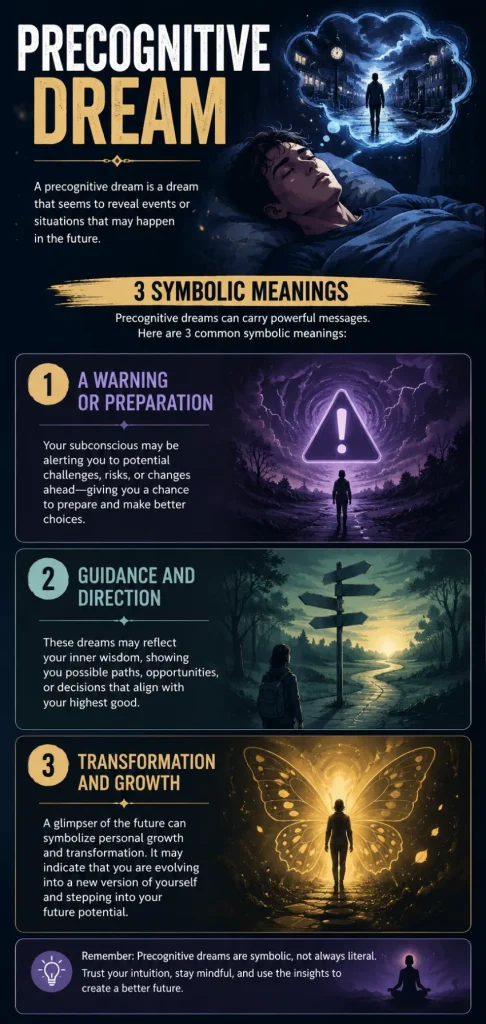
They May Act as a Warning
Imagine you’ve chosen a particular path in life.
Deep within your subconscious mind, you may already sense that something isn’t right.
Even though everything seems fine on the surface, your intuition may be picking up signs that you haven’t consciously noticed.
Then one night, you have a vivid dream about an unpleasant event that could happen in the future.
For those who believe in Precognitive Dreams, the message is simple: the dream offers you a chance to pause and reflect.
It may encourage you to rethink your decisions, avoid potential problems, or make changes before it’s too late.
Of course, whether these dreams truly predict future events or simply reflect your subconscious concerns is still a matter of personal belief.
Some people see them as meaningful warnings, while others view them as the mind processing hidden thoughts and emotions.
Whatever your perspective, many people find that paying attention to these dreams helps them become more aware of their choices and the direction their lives are taking.
How Do Precognitive Dreams Work?
There is no scientific proof that Precognitive Dreams can predict the future. However, researchers have proposed several theories to explain why some people believe their dreams come true.
1. Selective Recall: One explanation is selective recall. People are much more likely to remember a dream that seems to match a real-life event than the many dreams that never come true.
For example, if one dream appears to predict something that later happens, it often stands out in your memory. Dreams that don’t match future events are usually forgotten.
2. Tolerance for Ambiguity: Dreams are often symbolic and open to different interpretations. Some people are naturally more comfortable finding meaning in vague or uncertain experiences. Researchers refer to this as tolerance for ambiguity.
Because of this, they may be more likely to interpret a dream as a premonition after a similar event occurs in real life.
3. Paranormal Beliefs: Studies have found that people who believe in paranormal experiences are generally more likely to believe in Precognitive Dreams. They also tend to notice connections between events that might seem unrelated to others.
This doesn’t prove that precognitive dreams are real, but it may explain why some people are more likely to interpret their dreams as predictions.
4. Coincidence: Sometimes a dream may seem meaningful only after a similar event happens in real life.
When this occurs, it is easy to connect the dream with the event, even if the similarities are partly due to coincidence. Selective recall, personal beliefs, and individual interpretation can all influence how these connections are made.
5. Subconscious Connections: Many sleep experts believe that dreams help the brain process memories, emotions, and everyday experiences.
For example, imagine you’ve been thinking about redecorating your home for several days. You’ve looked at furniture online, visited stores, and discussed ideas with family. That night, you dream about buying a new sofa.
The next morning, you see an advertisement featuring the exact type of sofa you had in your dream. While this may feel like a prediction, the dream could simply reflect information your subconscious mind had already been processing.
Although many people believe Precognitive Dreams reveal future events, scientific research suggests that our memories, emotions, beliefs, and subconscious thoughts may play a significant role in creating these experiences.
Read : Can You Lucid Dream Without Sleep Paralysis? The Truth Revealed 5 step guide for powerful experience
What Causes Precognitive Dreams?
The exact cause of Precognitive Dreams is still unknown. While many people believe these dreams can predict future events, others consider them a form of pseudoscience because there is no conclusive scientific evidence to support the idea.
Still, some experiences make people wonder if there is more to these dreams than simple coincidence.
For example, imagine you dream about moving into a new house. In the dream, you are packing your belongings and leaving your current home, even though you believe you are perfectly happy living there.
A few months later, you unexpectedly find yourself moving to a new house. As you pack your bags, the situation feels almost identical to what you saw in your dream.
How could this happen?
One possible explanation is that your subconscious mind had already noticed things your conscious mind hadn’t fully recognized.
Perhaps you were becoming dissatisfied with your current home, even if you didn’t realize it at the time.
Your dream may have brought those hidden thoughts to the surface, making you more aware of your feelings. As time passed, those feelings could have influenced your decisions and encouraged you to look for a new place to live.
For example, you might have discovered a home that felt perfect for you. The excitement of finding your “dream home” may have motivated you to make the move, making the earlier dream seem like a prediction.
Whether Precognitive Dreams truly reveal future events or simply reflect your subconscious thoughts remains an open question.
Both scientific theories and personal experiences continue to shape the discussion, and many people are still fascinated by the possibility that dreams can sometimes appear to come true.
Famous Precognitive Dreams
Throughout history, several stories have been linked to Precognitive Dreams. While these accounts are fascinating, most are based on personal reports and cannot be scientifically verified. They are often shared as historical anecdotes rather than proven evidence that dreams can predict the future.
1. Abraham Lincoln’s Dream
One of the most well-known stories about Precognitive Dreams involves Abraham Lincoln.
According to historical accounts, Lincoln described a disturbing dream to several close friends and his wife shortly before his death.
In the dream, he walked through the White House and entered the East Room, where he saw soldiers and mourners gathered around a covered body.
Lincoln asked a soldier whose body it was. The soldier reportedly replied:
“The President. He was killed by an assassin.”
About two weeks later, Abraham Lincoln was assassinated while attending a theater performance. Because of the similarities between the dream and the real event, many people consider it one of the most famous examples of a possible precognitive dream.
2. Dreams before the Titanic Disaster
Another story often mentioned in discussions about Precognitive Dreams involves the sinking of the Titanic in 1912.
According to various reports, some people claimed they dreamed about the ship sinking before its maiden voyage. A few even said they canceled their tickets because of these dreams.
However, it’s important to consider the context.
At the time, the Titanic was one of the most talked-about ships in the world. Newspapers covered its construction extensively, and many passengers were naturally excited or anxious about the journey.
Because so many people were thinking about the voyage, it isn’t surprising that some dreamed about it.
Looking back after the disaster, those dreams may have seemed remarkably predictive, even if they were influenced by public attention, emotions, or coincidence.
These stories continue to spark curiosity about Precognitive Dreams, but they should be viewed with an open yet critical mind, as there is no conclusive scientific evidence proving that dreams can accurately predict future events.
Precognitive Dreams and Déjà Vu
Déjà vu is one of the most mysterious experiences many people have. It creates the strong feeling that you’ve already lived through a moment, even though it’s happening for the first time.
For some people, the experience is comforting. For others, it can feel strange, unsettling, or even a little frightening.
The feeling often becomes even more powerful when it’s connected to Precognitive Dreams.
Imagine having a vivid dream and then, days or even weeks later, finding yourself in a situation that feels exactly the same. When that happens, the sense of déjà vu can be incredibly intense.
Experiences like these naturally raise questions.
Was the dream a genuine glimpse of the future? Did your subconscious mind recognize patterns before you consciously noticed them? Or was it simply an unusual coincidence that your brain connected afterward?
Although science has not confirmed that Precognitive Dreams can predict future events, many people describe a strong feeling of familiarity when a dream seems to match something that later happens in real life.
Whether you see it as intuition, coincidence, or something beyond our current understanding, the connection between Precognitive Dreams and déjà vu continues to fascinate psychologists, researchers, and dream enthusiasts alike.
Read : Top 10 Lucid Dreaming Benefits: Unlock Your Mind’s Full Potential While You Sleep
Precognitive Dreams of Death
Have you recently dreamed about dying?
If so, it’s natural to wonder whether the dream is a warning or a sign of something that might happen in the future.
Before jumping to that conclusion, it’s worth knowing that dreams about death have been interpreted very differently throughout history.
In many cultures, a death dream was actually considered a positive symbol. Rather than predicting someone’s death, it was often believed to represent new beginnings, transformation, or even the arrival of new life within a family or community.
Today, many dream experts view death dreams in a similar symbolic way.
Instead of predicting a real death, they often represent change, personal growth, or the end of one phase of life and the beginning of another. For example, you may notice changes in your personality, career, relationships, or the behavior of someone close to you.
In some cases, dreams about death can also be influenced by stress, anxiety, or major life transitions.
For most people, these dreams are symbolic rather than literal. They remind us that life is constantly changing and encourage us to appreciate the people and moments that matter most.

What If You Dream About Someone Else Dying?
Dreaming about the death of a loved one, such as your partner, friend, or family member, is surprisingly common.
Although these dreams can feel upsetting, they usually do not mean that the person is going to die.
Instead, many interpretations suggest they reflect changes in the relationship, emotional distance, personal growth, or a new stage in your connection with that person.
When discussing Precognitive Dreams, it’s important to remember that not every vivid or emotional dream is a prediction. Many dreams are symbolic and are shaped by your thoughts, emotions, memories, and everyday experiences.
How Do Precognitive Dreams Work?
Precognitive Dreams are often described as dreams that appear to show future events before they happen. But how could that be possible?
No one knows for certain.
When you dream, your brain naturally draws on memories, emotions, and experiences from your daily life. That’s why many dreams include familiar people, places, or situations you’ve already encountered.
But what about dreams that seem to take place in the future?
Many people report having dreams that later resemble real-life events. Sometimes the similarities are so striking that they wonder whether the dream predicted what was about to happen.
For example, some people claim they dreamed about a major earthquake shortly before one actually occurred. Does that mean they had psychic abilities?
Not necessarily.
Considering how many people dream every night, it’s statistically possible that some dreams will closely match real-world events by coincidence. When this happens, the dream naturally becomes much more memorable than the countless dreams that never come true.
Even so, dreams about the future shouldn’t always be dismissed.
Whether they are true Precognitive Dreams, subconscious pattern recognition, or meaningful personal symbols, they can still encourage you to reflect on your thoughts, emotions, and life choices.
Some people believe these dreams act as warnings, while others see them as reassurance that they are moving in the right direction. From a psychological perspective, they may simply reveal concerns, hopes, or possibilities that your subconscious mind has already begun to process.
The next time you have a dream that seems to involve the future, consider writing it down in a dream journal. Even if the events never happen exactly as you imagined, the dream may still provide valuable insight into your emotions, intuition, and personal growth.
Ultimately, whether Precognitive Dreams are genuine glimpses of the future or fascinating creations of the subconscious mind remains an open question. Their true value may lie not only in whether they come true, but also in what they reveal about you.
Lucid Dreaming and Precognitive Dreams
What if you could consciously explore Precognitive Dreams?
It’s an intriguing idea. Imagine becoming aware that you’re dreaming and using that awareness to explore possible future events or gain deeper personal insights.
This is where lucid dreaming enters the discussion.
In a lucid dream, you realize that you’re dreaming while the dream is still happening. Some people can even influence or control parts of the dream, making lucid dreaming a unique experience for self-exploration.
Can Lucid Dreaming Lead to Precognitive Dreams?
There is no scientific evidence that lucid dreaming allows people to predict the future. However, some dream enthusiasts believe the two experiences can overlap in different ways.
They generally describe two possibilities:
- Ambient experience: The dreamer simply observes what appears to be a future event without trying to influence it.
- Active experience: The lucid dreamer intentionally attempts to experience a dream that may provide insight into future possibilities.
Whether these experiences are genuine Precognitive Dreams or vivid creations of the subconscious mind remains open to interpretation.
Rather than expecting dreams to reveal exact future events—such as lottery numbers or other specific outcomes—many people use lucid dreaming as a tool to better understand their thoughts, emotions, and intuition.
The Real Value of Precognitive Dreams
One of the most meaningful lessons from Precognitive Dreams is not necessarily about predicting the future. Instead, they can encourage you to reflect on your current choices.
If a dream shows a future that feels uncomfortable, ask yourself:
“Is there anything I can do today to change this outcome?”
In many cases, the answer may be yes.
Even if the dream isn’t a literal prediction, it could be highlighting fears, hopes, or possibilities that deserve your attention. Acting on those insights may help you make better decisions in your waking life.
Likewise, if a dream leaves you feeling hopeful or inspired, let it motivate you to continue moving toward your goals.
Whether you view Precognitive Dreams as spiritual experiences, subconscious guidance, or meaningful coincidences, they remind us of one important truth: while we cannot control every event in the future, we can always choose how we respond today.
That may be the greatest lesson dreams have to offer.
Read : 5 easy step to practice Wake Initiated Lucid Dreaming
Are precognitive dreams scientifically proven? – Final Thoughts
Precognitive Dreams have fascinated people for centuries. Some believe they offer glimpses of future events, while others see them as the subconscious mind processing memories, emotions, and hidden patterns.
Although there is no conclusive scientific evidence proving that dreams can predict the future, many people continue to share personal experiences that are difficult to ignore.
Whether you interpret these dreams as spiritual messages, meaningful coincidences, or psychological insights, they can still provide valuable opportunities for self-reflection.
Paying attention to your dreams may help you better understand your thoughts, emotions, and the choices you’re making in everyday life.
If you frequently experience dreams that seem to come true, consider keeping a dream journal.
Recording your dreams as soon as you wake up can help you identify recurring themes, notice patterns over time, and separate genuine similarities from ordinary coincidences.
In the end, the true value of Precognitive Dreams may not lie in predicting the future, but in encouraging greater awareness of yourself and your life. By approaching these experiences with both curiosity and critical thinking, you can appreciate the mystery of dreams while staying grounded in reality.
Frequently Asked Questions (FAQs)
Is It Normal to Have Precognitive Dreams?
Yes, many people report having experiences they describe as Precognitive Dreams, where a dream appears to match a future event. While these experiences are relatively common, there is no scientific evidence proving that dreams can accurately predict the future. In many cases, psychologists believe memory, coincidence, and subconscious pattern recognition may explain why some dreams seem prophetic. Regardless of the explanation, having an occasional dream that feels predictive is generally considered a normal human experience.
Is Precognition a Gift From God?
The answer depends on your personal beliefs and religious tradition. Some spiritual traditions consider precognition to be a divine gift or a form of spiritual guidance, while others interpret it as intuition or heightened awareness. From a scientific perspective, there is currently no evidence confirming that precognition is a supernatural ability. Whether you see Precognitive Dreams as a gift from God, a spiritual experience, or the work of the subconscious mind is ultimately a matter of personal faith and interpretation.
What Is the Rarest Dream to Have?
There is no official list of the rarest dream types, but some dream researchers consider highly detailed lucid dreams, false awakening dreams, and experiences that people describe as Precognitive Dreams to be among the least commonly reported. Because dreams are deeply personal and difficult to study, it’s impossible to say with certainty which type is truly the rarest.
How Can You Induce Precognitive Dreams?
There is no scientifically proven method for inducing Precognitive Dreams. However, some people believe that improving dream recall can increase the chances of noticing meaningful dream patterns. Common practices include keeping a dream journal, getting enough sleep, practicing meditation, reducing stress, and setting an intention before going to bed to remember your dreams. While these habits may improve dream awareness, they do not guarantee dreams that predict future events.
What Does Psychology Say About Precognitive Dreams?
From a psychological perspective, Precognitive Dreams are generally explained through processes such as subconscious pattern recognition, selective recall, confirmation bias, and memory. Your brain constantly processes information that you may not consciously notice during the day. These hidden observations can appear in your dreams and sometimes seem to match future events. Although psychology does not consider precognitive dreams to be proven evidence of predicting the future, it recognizes that dreams can provide valuable insight into emotions, thoughts, and unconscious concerns.