
Learning How to Trigger a Lucid Dream can transform an ordinary night of sleep into a conscious journey where you recognize the dream, stay aware, and explore the possibilities of your own mind.
Ever experienced a dream where you suddenly got the feeling that you were actually dreaming?
That moment when you become conscious while you are being a participant in a dream is called as a Lucid Dreaming, a state where you still dream and become conscious that you are dreaming at the same time.
The occurrence of lucid dreaming has become a fascination for many people since it offers an exciting opportunity for self-discovery, exploration and also understanding the way our brain works during sleep.
Acquiring the ability to trigger lucid dreaming doesn’t require some extraordinary talent; still it demands your time, effort, and understanding your sleeping and dreaming patterns better.
Dreaming techniques such as: reality checking, recording your dreams into a journal, Mnemonic Induction of Lucid Dreams (MILD), Wake Back to bed (WBTB), and visualization are frequently applied to boost the odds of becoming aware while dreaming.
You can get into a lucid dream if you have the natural ability, though others may need quite some effort before achieving the desired outcome and recognizing that they are dreaming.

You can start by working on your remembering dreams after sleep, noticing the recurring theme in your dreams, and training yourself to constantly check whether you are dreaming or not.
In this article you can learn
- Step-by-step how to get into a lucid dream
- discover the methods most effective for beginners to learn How to Trigger a Lucid Dream
- how your sleep and ability to remember dreams play a role, and finally,
- Mistakes you should avoid if you want to make the most out of lucid dreaming without interfering with your sleep patterns.
Whether you have never had a lucid dream or are aware on some level that you are dreaming, knowing these methods will help you lucid dreaming in a very systematic, practical, and even safe, if we may say, manner.
- What Is Lucid Dreaming?
- Lucid Dreaming vs. Sleep Paralysis
- How to trigger a lucid dream: 10 best lucid dream triggers
- What is lucid dreaming?
- Is lucid dreaming a new concept?
- When does lucid dreaming usually happen?
- Can anyone learn how to trigger a lucid dream?
- What does a lucid dream feel like?
- Is lucid dreaming scientifically proven?
- What can lucid dreaming be used for?
- Can lucid dreaming help with nightmares?
- Can lucid dreaming improve creativity?
- Are there any dangers or risks of lucid dreaming?
- Can lucid dreaming become a form of escapism?
- Should everyone practise lucid dreaming?
What Is Lucid Dreaming?
Lucid dreaming is a phenomenon in which a person becomes aware that they are dreaming while still asleep. In simple words, you know that the dream is not real, even though you are still inside the dream.
Learning how to trigger a lucid dream involves developing this awareness while your body and mind remain in a state of sleep.
Studies suggest that around 55% of people have experienced at least one lucid dream. In approximately one-third of these dreams, the dreamer may also be able to influence or control what happens in the dream.
Lucid dreams are different from vivid dreams. A vivid dream is simply a dream that feels very realistic and can be remembered in great detail after waking up.
A lucid dream can also be vivid, but the main difference is awareness. During a lucid dream, you realize that you are dreaming while the dream is still happening.
This awareness is an important part of understanding how to trigger a lucid dream.
Research suggests that lucid dreaming usually occurs during rapid eye movement (REM) sleep, which is the stage of sleep when most dreams occur.
REM sleep periods become longer as the night continues, so lucid dreams may be more likely to happen during the second half of your sleep.
Lucid Dreaming vs. Sleep Paralysis
Sleep paralysis is another experience connected to REM sleep that involves a high level of awareness. However, it is quite different from lucid dreaming, and understanding these differences is useful when learning how to trigger a lucid dream.
During sleep paralysis, a person becomes aware of their surroundings but is temporarily unable to move their body. Some people may also experience hallucinations during this state.
Similar to lucid dreaming, the experience is often remembered in vivid detail after waking up.
However, lucid dreaming is generally a more active experience. The dreamer becomes aware that they are dreaming and may be able to interact with, influence, or guide the dream.
Sleep paralysis, on the other hand, is mostly a passive experience in which the person is aware but unable to move.
While lucid dreaming is often associated with curiosity, excitement, or positive experiences, sleep paralysis can feel frightening.
Studies suggest that around 80% to 90% of people who experience sleep paralysis associate the experience with fear. Therefore, sleep paralysis and lucid dreaming are not the same, even though both are connected to REM sleep and involve awareness during the sleep cycle.
How to trigger a lucid dream: 10 best lucid dream triggers
The most important thing is to build a few simple habits and practice some of the most effective lucid dream triggers. By practicing the following techniques regularly, you can train yourself and learn how to trigger a lucid dream.
Please make sure to read the final tips, as they include some important points that you do not want to miss.
1. Dream Journal
Keeping a dream journal is one of the best things you can do when learning how to trigger a lucid dream?
It is simple, enjoyable, and highly effective for improving your dream recall and making your dreams feel more vivid. Remembering your dreams is also an important step toward becoming aware that you are dreaming.
Start by writing down your dreams every morning as soon as you wake up.
Even if you can remember only a small part of a dream, write it down. With regular practice, your ability to remember dreams can improve over time, helping you recognize patterns and eventually experience lucid dreams.
2. Reality Checks
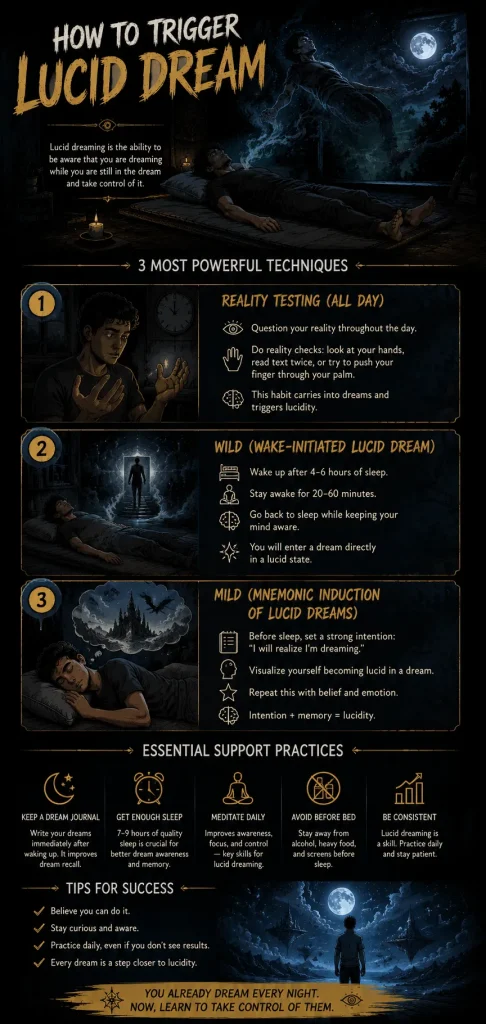
Reality checks are another simple and powerful technique for learning how to trigger a lucid dream. Research has tested several common lucid dreaming techniques, and reality checks are one of the methods often used to help people become aware that they are dreaming.
A reality check is a simple action or test that helps you determine whether you are awake or dreaming. The goal is to make this habit so regular that you eventually perform the same check inside a dream. When something unusual happens, it may help you realize that you are dreaming and trigger lucidity.
The key is to practice reality checks regularly and with real intention. When you frequently question your reality during the day, this habit may also appear in your dreams.
One of the easiest reality checks is to ask yourself:
“Am I dreaming right now?”
When asking this question, pay close attention to your surroundings. Take a moment to observe everything around you and genuinely consider whether you could be dreaming.
You can also try a physical reality check. For example, try to push one finger through the palm of your other hand. In real life, your finger cannot pass through your palm. But in a dream, the result may be different.
If you perform this action inside a dream and notice that your finger passes through your hand, this unusual result can help you realize that you are dreaming. This sudden awareness can trigger lucidity immediately.
Reality checks may seem simple, but practicing them regularly can help build the awareness needed when learning how to trigger a lucid dream.
For more ideas, you can also explore different types of reality checks and learn how to perform them effectively inside a dream.
3. Wake Back to Bed (WBTB) Technique
The Wake Back to Bed (WBTB) technique was another method included in the research. It is a simple technique that can help you learn how to trigger a lucid dream by increasing your chances of entering REM sleep after waking up.
To use this technique, set an alarm to wake yourself after about five or six hours of sleep. For example, if you go to bed at 11:00 p.m., you can set your alarm for around 4:00 or 5:00 a.m.
After waking up, stay awake for around 10 to 20 minutes. Then, go back to bed and try to return to sleep.
The idea behind this technique is that when you go back to sleep after several hours of rest, you may enter the REM sleep stage more quickly. REM sleep is the stage where most dreaming occurs. This can increase your chances of becoming aware during a dream and experiencing lucidity.
For this reason, the WBTB technique is considered one of the popular methods for people learning how to trigger a lucid dream.
You can also read a detailed guide to learn more about how to perform the WBTB technique and use it effectively for lucid dreaming.
Read : How to Know If You Had a Precognitive Dreams: 10 Signs, Science & Spiritual Meaning
4. Mnemonic Induction of Lucid Dreams (MILD)
The Mnemonic Induction of Lucid Dreams (MILD) technique was the third method included in Dr. Aspy’s study. It is a powerful technique that can help you learn how to trigger a lucid dream.
The MILD technique works best when you have a strong intention and practice the method regularly. Its main purpose is to increase your self-awareness while you are dreaming.
This technique works by preparing your mind for your next dream. You imagine yourself becoming aware inside a dream and recognize that you are dreaming. You can also use this method to create specific triggers or reminders that may help you become lucid during a dream.
The MILD technique is based on something called “prospective memory.”
Prospective memory is your ability to remember to do something in the future.
By repeating a phrase such as, “The next time I’m dreaming, I will remember that I’m dreaming,” you set a clear intention before falling asleep. Repeating this intention can help train your mind to recognize when you are dreaming.
With regular practice, this method may increase your chances of remembering your intention during a dream, which can help trigger lucidity and teach you how to trigger a lucid dream.

5. Mindfulness
Mindfulness can help you become more conscious and aware of yourself and your surroundings. This increased awareness may also help you learn how to trigger a lucid dream.
Why is this important?
When you become more aware during your waking life, you may have a better chance of recognizing when something feels unusual in a dream. This awareness can help you realize that you are dreaming and trigger lucidity.
Research has found a relationship between mindfulness and lucid dreaming.
People who practice meditation and mindfulness may be more likely to develop greater awareness, which can also support dream awareness. Some meditators also report remembering and experiencing lucid dreams more often.
Mindfulness is therefore a useful habit to include when learning how to trigger a lucid dream.
You can practice it through simple meditation, paying closer attention to your thoughts, or becoming more aware of your surroundings during the day.
A simple meditation practice can also be helpful for beginners who want to improve their awareness and prepare their mind for lucid dreaming.
6. Wake-Initiated Lucid Dreams (WILD)
As the name suggests, the Wake-Initiated Lucid Dreams (WILD) technique helps you enter a lucid dream directly from a waking state. Instead of first falling asleep and becoming aware later in a dream, you try to keep your mind aware while your body gradually falls asleep.
This technique can be useful for people learning how to trigger a lucid dream, but it usually requires patience and regular practice.
Step 1: Lie Down Comfortably
Lie down in a comfortable position, preferably on your back, and relax completely for around 10 to 20 minutes.
Try to keep your body relaxed and avoid unnecessary movement. The goal is to allow your body to slowly prepare for sleep while keeping your mind calm.
Step 2: Observe Your Hypnagogic State
After some time, you may start seeing unusual images, patterns, sounds, or other strange sensations.
Do not worry. This is known as hypnagogia, or hypnagogic hallucinations, which is the transitional state between wakefulness and sleep.
Simply observe these experiences without becoming too excited or actively reacting to them.
Step 3: Create a Dream Scene
At this stage, begin thinking more deeply about the dream scene you want to experience.
Imagine a dream environment or landscape in your mind. Try to focus on the details and slowly allow yourself to become more involved in the scene.
Step 4: Mind Awake, Body Asleep
Your body should gradually fall asleep while your mind remains aware.
This is one of the main parts of the WILD technique. You need to prepare mentally and practice learning how to stay conscious while your body enters sleep.
With practice, this can help you move directly from a waking state into a dream, which is one way to understand how to trigger a lucid dream.
Step 5: Stabilize Your Lucid Dream
Once you enter a dream and become aware that you are dreaming, try to remain calm and stabilize the experience.
Becoming too excited can sometimes cause you to wake up. To maintain the dream, you can perform a few reality checks or focus on the details around you.
The WILD technique can be highly effective, but it may take time and regular practice to learn. This is only a brief introduction to the method. A detailed WILD guide can provide additional tips and answers to common questions about practicing this technique.
7. Binaural Beats
Binaural beats are special audio tracks that may influence brain activity and help create a relaxed mental state. Some people use them for sleep, relaxation, and meditation, and they may also be used as part of a routine for learning how to trigger a lucid dream.
Binaural beats work by playing two slightly different frequencies at the same time, with one tone presented to each ear.
To use binaural beats for lucid dreaming, follow these steps:
1. Lie Down Comfortably
Lie down in a comfortable position, put on your headphones, play the binaural beats, and relax.
Tip: You can also use an eye mask to block out light and create a darker environment.
2. Set an Intention
Use lucid dreaming affirmations and repeat them silently in your mind. For example, you can repeat your intention to recognize when you are dreaming.
You can also visualize the dream scene you want to experience.
3. Focus on the Sound and Relax
Focus your attention on the sound and allow your mind to relax. Let your thoughts wander naturally, but try to remain calm and avoid unnecessary movement.
4. Optional: Use another Technique, Such as WILD
After listening to the binaural beats for around 15 to 20 minutes, you can try another lucid dreaming technique, such as the WILD method.
Combining binaural beats with relaxation, visualization, and other techniques may support your practice as you learn how to trigger a lucid dream.
Read : Can You Lucid Dream Without Sleep Paralysis? The Truth Revealed 5 step guide for powerful experience
8. Using Sleep Paralysis to Trigger a Lucid Dream
Do you remember the “Mind Awake, Body Asleep” part of the WILD technique? Sleep paralysis is related to a similar state, where the body remains temporarily unable to move while the mind can still be aware.
Sleep paralysis can sometimes include vivid images, sounds, or other unusual sensations. These experiences can feel frightening, but they are not always scary. For some people, this state can become a transition into a dream.
If you are comfortable with sleep paralysis, you can use the experience as part of your lucid dreaming practice. However, it is important to remember that sleep paralysis is not a guaranteed way to trigger a lucid dream, and deliberately trying to induce it may be uncomfortable for some people.
The Easiest Way to Use Sleep Paralysis for Lucid Dreaming
1. Lie down comfortably
Get into a comfortable position in your bed and relax. You can use a short meditation to calm your mind while allowing your body to become sleepy.
2. Stay calm if you feel unable to move
At some point, you may experience the feeling that your body is temporarily paralyzed while your mind remains awake. If this happens, try not to panic. Remind yourself that the sensation will pass.
3. Keep your thoughts positive
Focus on staying calm and repeat simple affirmations silently, such as:
- I am safe.
- This is only a temporary experience.
- I will become aware in my dream.
Your intention and ability to remain relaxed are important parts of the process.
4. Allow the experience to develop naturally
Instead of fighting the sensations, remain calm and let yourself return to sleep. You may begin experiencing dream-like images or sensations as you transition into sleep.
If a dream develops and you become aware that you are dreaming, you may be able to enter a lucid dream. This makes sleep paralysis another possible approach for people exploring how to trigger a lucid dream.
If sleep paralysis becomes frightening or regularly disrupts your sleep, it is better to stop trying to induce it and focus on gentler lucid dreaming techniques instead.
9. Good Sleep Hygiene
Good sleep hygiene may sound basic, but it is an important part of learning how to trigger a lucid dream. If you regularly have trouble sleeping, it is better to improve your sleep habits first.
Getting good-quality sleep can increase your chances of becoming aware during a dream.
Here are some important sleep habits to consider:
1. Maintain a Regular Sleep Schedule
As mentioned earlier, most dreaming occurs during REM sleep, and REM periods generally become longer as the night progresses. Getting enough quality sleep can therefore give you more opportunities to experience dreams and become aware while dreaming.
Try to maintain a consistent sleep schedule and aim for around 7–8 hours of sleep each night.
2. Sleep in a Dark Room
A dark sleeping environment can help signal to your body that it is time to sleep. Reducing exposure to light at bedtime may also support the body’s natural production of melatonin, a hormone involved in regulating the sleep-wake cycle.
For a darker sleeping environment, consider using blackout curtains or an eye mask to block unwanted light.
Some people also explore melatonin as part of their lucid dreaming routine, but it is not necessary for everyone and should not be treated as a guaranteed way to trigger a lucid dream.
3. Create a Peaceful and Quiet Environment
Noise can interrupt your sleep and make it harder to stay asleep. A quiet bedroom can help you maintain better-quality sleep throughout the night.
If you cannot eliminate outside noise, you can try using earplugs or a white noise machine to reduce or mask distracting sounds.
Improving your sleep environment may seem simple, but it can make your overall lucid dreaming practice easier and more consistent. Good sleep is an important foundation when learning how to trigger a lucid dream.
Read : The Rausis Lucid Dreaming Technique: A 100% Powerful Guide to Instant Lucid Dreams
10. Recognize Your Dream Signs
One of the most useful ways to learn how to trigger a lucid dream is to pay attention to the patterns that appear in your dreams.
For example, recurring dreams about flying can become a strong dream sign. Once you recognize that flying often happens in your dreams, noticing it again may remind you that you are dreaming.
Your dream journal can help you identify these patterns. Review your previous dreams and look for things that appear regularly.
1. Do You Have Repetitive Dream Themes?
Look for themes or situations that frequently appear in your dreams, such as flying, running away from a monster, exploring strange places, or being in unusual environments.
2. Do Certain People or Things Keep Appearing?
Pay attention to people, objects, places, or situations that repeatedly show up in your dreams. These can become personal dream signs that help you recognize when you are dreaming.
The more familiar you become with your own dream patterns, the easier it may be to notice when something unusual happens.
Simply put, identifying your personal dream signs can help you recognize when you have entered the dream world. This awareness can become a useful part of your practice when learning how to trigger a lucid dream.
Conclusion: How to Trigger a Lucid Dream
Learning how to trigger a lucid dream does not have to be complicated. The key is to develop simple habits, improve your dream awareness, and give your mind enough time to recognize when you are dreaming.
Start with the basics, such as keeping a dream journal, performing regular reality checks, practicing mindfulness, and recognizing your personal dream signs.
These habits can improve your dream recall and help you become more aware of your dreams.
You can also experiment with techniques such as Wake Back to Bed (WBTB), Mnemonic Induction of Lucid Dreams (MILD), and Wake-Initiated Lucid Dreams (WILD). Binaural beats and visualization may also be included in your routine if you find them relaxing and helpful.
Good sleep habits are just as important. Maintain a regular sleep schedule, get enough sleep, and create a comfortable, dark, and peaceful sleeping environment.
Remember that lucid dreaming should not come at the cost of healthy sleep.
Most importantly, be patient. You may not experience a lucid dream on your first attempt, and that is completely normal. Keep practicing, pay attention to your dreams, and learn which techniques work best for you.
With consistency and a little patience, you can improve your dream awareness and increase your chances of experiencing lucid dreams.
The journey of learning how to trigger a lucid dream is different for everyone, so focus on building habits that feel comfortable and sustainable for you.
FAQ
What is lucid dreaming?
Lucid dreaming is a state in which you become aware that you are dreaming while the dream is still happening. Once you recognise that you are inside a dream, you may be able to observe, interact with, or sometimes influence the dream. However, becoming lucid does not always mean that you have complete control over everything in the dream.
Is lucid dreaming a new concept?
No. The idea of becoming aware during dreams has been discussed for centuries. Ancient Greek philosopher Aristotle described an example of awareness during dreaming, while Dutch psychiatrist and writer Frederik van Eeden introduced the term “lucid dream” in 1913.
When does lucid dreaming usually happen?
Lucid dreams most commonly occur during REM (rapid eye movement) sleep, the stage associated with vivid dreaming. They may be more likely during the early morning hours or shortly before waking. Some induction techniques can also encourage dream awareness while you are falling asleep.
Can anyone learn how to trigger a lucid dream?
Many people can learn lucid-dreaming techniques with regular practice. Some individuals naturally experience lucid dreams, while others may need more time to develop the skill. Improving dream recall, keeping a dream journal, practising reality checks, and using techniques such as MILD or WBTB can help increase awareness during dreams.
What does a lucid dream feel like?
The experience varies from person to person. Some lucid dreams may feel remarkably vivid and realistic, while others may feel more like ordinary dreams. Colours, sounds, emotions, movement, and physical sensations can sometimes seem unusually intense. The defining feature is simply the awareness that you are dreaming.
Is lucid dreaming scientifically proven?
Yes. Lucid dreaming is a recognised phenomenon that has been investigated in sleep research. Researchers have used physiological measurements and pre-agreed eye-movement signals to identify periods in which participants became consciously aware while dreaming.
What can lucid dreaming be used for?
Lucid dreaming can have several potential uses beyond entertainment. People may use it to explore their dreams, experiment with creativity, rehearse experiences, or respond differently to recurring nightmares. During a nightmare, recognising that the experience is a dream may help some people change the dream, reduce fear, or wake themselves up.
Can lucid dreaming help with nightmares?
For some people, lucid dreaming may provide a way to respond differently to nightmares. Once you realise that you are dreaming, you may be able to remind yourself that you are safe, change aspects of the dream, or deliberately wake up. However, lucid dreaming should not be considered a replacement for professional help when nightmares are severe or persistent.
Can lucid dreaming improve creativity?
Lucid dreams can provide an unusual environment for imagination and experimentation. Because dreams can create unfamiliar combinations of images, ideas, places, and experiences, some people use them as a source of creative inspiration. However, claims that specific famous discoveries or works were entirely created through dreams should be treated carefully unless there is reliable historical evidence.
Are there any dangers or risks of lucid dreaming?
Lucid dreaming itself is generally considered a sleep phenomenon rather than something that can physically trap you in a dream or cause you to die in real life. However, some people may experience frightening or emotionally intense dreams. Techniques that repeatedly interrupt sleep may also affect sleep quality if overused.
Can lucid dreaming become a form of escapism?
It can become unhelpful if someone becomes excessively focused on dreaming as a way to avoid everyday responsibilities or real-world problems. Lucid dreaming is best approached as an occasional skill or experience rather than a substitute for normal waking life.
Should everyone practise lucid dreaming?
Not necessarily. People who have difficulty distinguishing dreams from waking experiences, or who have certain mental-health or sleep-related concerns, should speak with a qualified healthcare professional before deliberately using techniques that alter or interrupt normal sleep patterns.